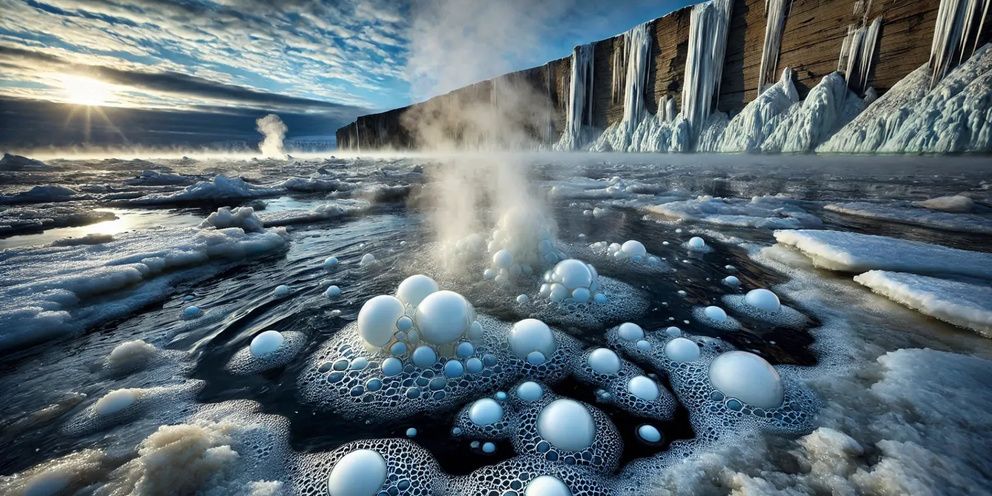
Scientists have discovered large-scale methane emissions in Antarctica
A group of Spanish researchers reported the identification of significant methane emissions in the depths of Antarctica during their expedition. El País newspaper reports this, citing geologists Ricardo Leon and Roger Urgeles.
Scientists aboard the ship Sarmiento de Gamboa observed methane emissions in the ocean up to 700 meters long and up to 70 meters wide.
According to the authors of the study, these emissions could serve as a “bomb for the planet’s climate.”
It is clarified that methane accumulated in the depths of the sea about 20 thousand years ago as a result of the decomposition of organic substances in the form of methane hydrates. Roger Urgeles compared the gas to burning ice, emphasizing its danger.
He added that the area contains 24 gigatons of carbon in methane hydrates, which is equivalent to the emissions of two years of human activity. The newspaper also explains that frozen methane, which is in a solid state, can become gaseous.
Ricardo Leon noted that such phenomena were observed in the Arctic, but they were recorded for the first time in Antarctica.
While the scientists' findings remain preliminary, they suggest gas is coming to the surface along geological faults.
In addition, Spanish researchers have expressed concerns that unstable marine sediments could lead to serious landslides on the continental slope, which in turn could trigger a tsunami.
Roger Urgeles explained that when methane hydrates turn into gas, their volume increases 160 times.
“If the gas does not dissipate quickly, it could lead to massive landslides,” he added.