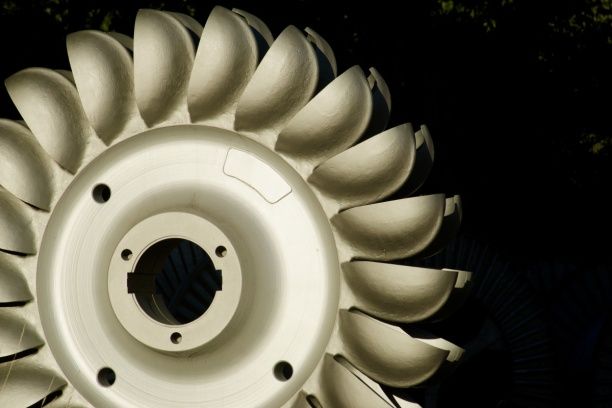
The innovative development of Perm Polytechnic specialists made it possible to significantly reduce the error when testing turbines
Perm Polytechnicians have improved the test bench and developed an innovative method for determining the power and torque of turbines. This was reported by the university press service.
"Unlike traditional approaches based on measuring the angle of torsion of a spring, the new system uses paired vibration sensors. They are installed on the bearings of the measuring spring and other structural elements of the stand. The twisting of the measuring spring occurs under the influence of torque, and the turbine speed is subject to fluctuations even in a stable mode. This is especially noticeable during transient processes - changes in speed or load - torsional vibrations occur, introducing an error in the measurement torque. Installing sensors at an angle of 90° to each other allows you to record not only the angle of rotation of the spring and the phase angles of its displacement, but also the vibration parameters, temperature and frequency of torsional vibrations. The system automatically analyzes these data and calculates dynamic coefficients that correct the measured torque value,” explains Alexey Salnikov, professor at PNIPU.
In this way, the spring angle, which is directly related to the turbine torque, is measured with high precision, minimizing the influence of external factors such as vibration and temperature fluctuations.
“The use of this technology has made it possible to reduce the overall measurement error from 15-20% to 4.5-7%, that is, almost threefold. This is extremely important when testing aircraft engines, installations, compressors and other rotary machines. Moreover, our technique allows us to estimate power with high accuracy not only in stationary modes, but also during transient processes, for example, when accelerating or decelerating a turbine,” notes Sergey Bochkarev, professor at PNIPU.
Practical tests have confirmed that the new method provides more accurate results. For example, the operation of the stand was tested when the spring was heated, which usually leads to deformation of the twist angle and, as a consequence, to an error in the measurement. At a rotation speed of 14,000 rpm, the error of the developed stand was only 6.9%.
A new methodology for bench testing of turbines opens up prospects for a more accurate assessment of the energy parameters of equipment, which is especially important for the aviation, energy and other industries. The introduction of this method will not only improve the quality of testing, but also reduce the cost of redesigning structures due to more reliable data.